
The Cottonwood Apple Tree
A community orchard we are building on ancestral land, one tree, one soil test and one load of water at a time.

We want our children's first memory of this land to be growing up alongside these trees, and one day handing the fruit to their own kids.
This field has fed our families before. Our grandparents planted here, hauled water here and read this land with a knowledge no satellite can replace. We call that ancestral intelligence, and it is the reason we are doing this.
This is what we want for the many families we work with. To take what our elders remember about their fields and orchards and bring it back into reality, so their children and grandchildren can walk those rows too.
Every tree here is a promise. If we plant it, test the soil, bring the water and take care of the wash that feeds it, the land will take care of the next generation.

Family
Trees that grow up with our children and outlast us.
Food sovereignty
Fresh fruit grown in Tselani/Cottonwood, by us, for us.
Water and land
Slow the water down, keep it in the soil, heal the wash.
A self sustaining orchard
Our goal is an orchard that stands on its own. Water in the ground instead of in a tank. Soil that feeds the trees. A wash that holds the rain. And a place where our community comes to learn.
-
Plant 170 more trees
131 of 300Grow from 131 fruit trees to 300, with more apples, pears and stone fruit suited to our high desert.
-
Drill a well
PlanningBring water up on site so the trees get watered on time and the hauling stops.
-
Restore the wash
Final clearanceBuild low tech erosion control structures so the wash slows down and recharges the ground, without moving the channel.
-
Build the soil
OngoingKeep adding organic matter, mulch and amendments so the soil holds more water every year.
-
Open an outdoor classroom
StartingTeach planting, pruning, water harvesting and ancestral knowledge right here in the rows, for students, families and anyone who wants to grow food.

There is a place for you here
This orchard has never been one person's work. Family, neighbors and friends have carried buckets, rolled out fence mesh and planted trees side by side. If this story means something to you, we would love for you to be part of what comes next.
Put a tree in the ground
170 trees go in next. We want every one of them planted by the people who helped make it possible.
Help bring the water home
A well changes everything here. Everyone who stands behind it is part of the day the hauling stops.
Restore the wash with us
The erosion control structures are built by hand with logs and woven branches. Come build one and watch it hold the rain.
Share what you know
Bring your class, your elders and your stories. What our grandparents knew about this land belongs in this classroom.
To get involved, reach out to us at planconservation@gmail.com or 928-349-2014, or visit planconservation.com.
Before one tree went in the ground
An orchard on the Navajo Nation starts with paperwork and relationships. Here are the steps we took to secure the field and the funding.
- 01
Secured the field
Worked through the land use process for the field so the orchard has a clear, lasting home.
- 02
Wrote our own conservation plan
Mapped the field, the wash and the soils, and set the practices we would follow. We built the plan with Ancestral Intelligence, the automated conservation planning platform we developed. It is the newest tool of its kind, made to turn what families know about their land into plans that meet BIA and USDA requirements. This is the same work we now do for other families.
- 03
Secured funding from First Nations Development Institute
We were awarded a Beginning Farmer and Rancher Fellowship grant, which helped us get the orchard in the ground.
- 04
Built the field and prepared the ground
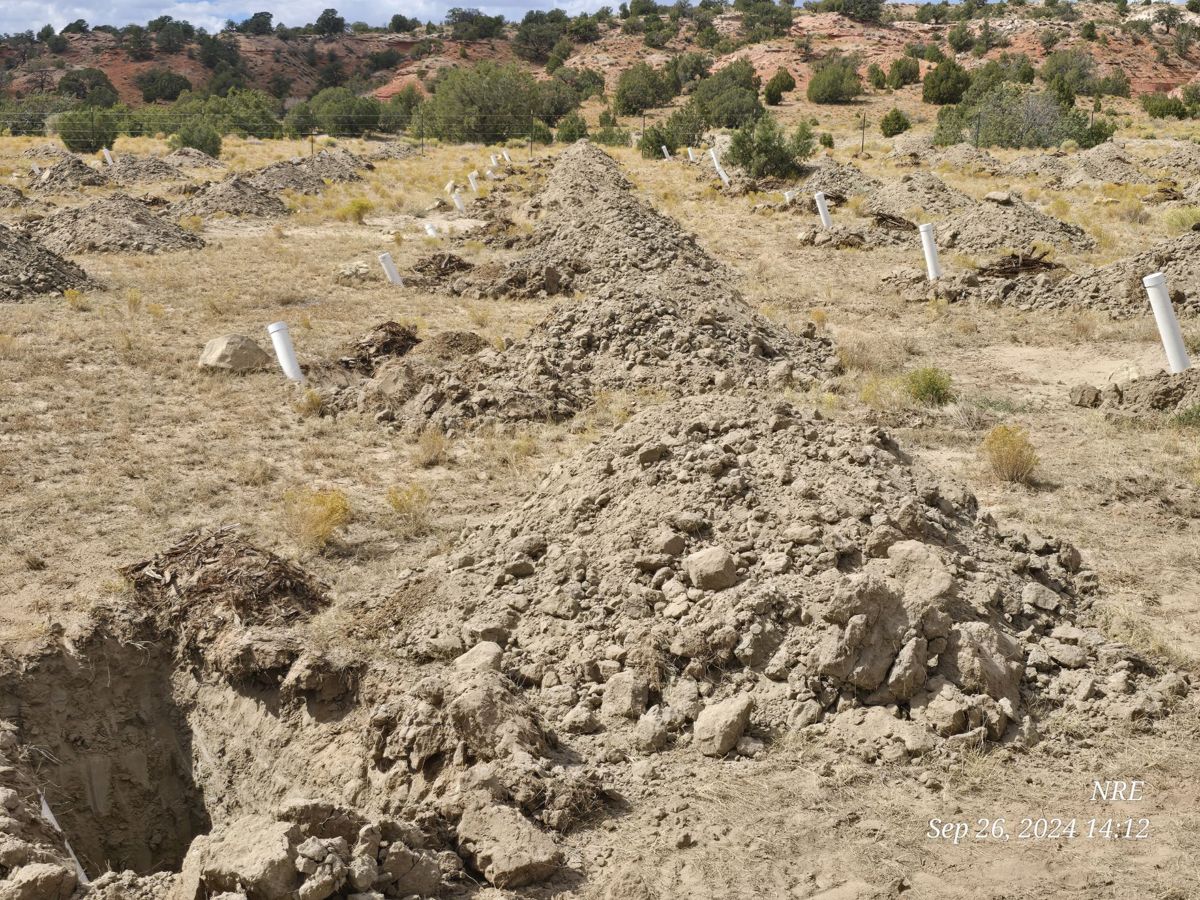
We dug every planting hole and set a PVC watering pipe at each one, ready for our chosen planting method, the Ellen White method.
- 05
AZDA Soil Health Grant
We proposed the Cottonwood Apple Tree Induced Meandering project to the Arizona Department of Agriculture and received conditional approval for grant SoilHealth26-01. We revised the budget to rent equipment instead of buying it, so more dollars go into the ground.
Soil first, then trees
We tested the soil before we planted anything. Then on September 20, 2024, we planted 131 fruit trees, and every single one went in using the Ellen White method.
Soil testing
We pulled soil from the planting holes across the field and ran jar tests to see what we are working with. Shake soil and water in a jar, let it settle, and it separates into sand, silt and clay. That told us how much each hole needed to be built up before a tree went in.

The Ellen White method
This method builds a living home for each tree instead of just digging a hole. We followed it for all 131 trees, working from the bottom of the hole up:
- Dig big. An outsized hole about three feet across.
- Feed the bottom. A mix of compost, leaf mould, topsoil and tree planting minerals.
- Rocks and air. A layer of small rocks with a 4 inch air tile so air reaches deep into the hole.
- Topsoil and root mix. Topsoil, then compost, peat moss, leaf mould, topsoil and minerals around the roots.
- Protect the trunk. A large tin can around the base of the young tree.
- Mulch on top. An inch of compost, three inches of leaf mulch, then rock mulch to hold in moisture.
We learned the method from Azure Farm's guide and videos on YouTube. If you try it, understand your soils first. Every field is different, and your soil tells you what each hole needs.
Watering in
At planting we added root stimulator, then set a PVC pipe at every tree so water goes about three feet down to the roots. Every gallon of that water is hauled in.
Caring for the trees
We prune in spring and summer, painted the trunks in July 2025 to stop sunburn, keep up the fenceline every month, and walk the orchard daily to keep prairie dogs, moles, squirrels and birds away. In fall 2025 we picked our first fruit.


Hauling water like crazy
Every one of our 131 fruit trees has been watered with hauled water. We fill a 500 gallon tank at the Cottonwood Chapter windmill, bring it back on the trailer, and we water by hand at the root zone and down PVC pipes set about three feet deep.

Gallons hauled each month
Solid bars are from our watering log. Striped bars are our 2026 estimate. Hover or tap a bar for the details.
See the monthly log as a table
| Month | Waterings | Gallons per tree | Total gallons | Tank loads | Notes |
|---|
How the season runs
Most waterings are 5 gallons a tree. With 131 trees that is 655 gallons, or two trips with the 500 gallon tank. When it gets hot we go to 10 gallons a tree, 1,310 gallons and three trips.
The water follows the heat. June, July and early August are when we haul the most. From mid August into September and October the monsoon comes in, so we haul less and let the rain do the work. In winter, snow and frozen ground carry the trees and we stop hauling completely.
The one exception was planting. For the first three weeks we gave every new tree 10 gallons, deep and at the surface, to get the roots established.
This year
We have not caught up our 2026 log yet, so the striped bars are our estimate. This spring was drier than last, so we hauled more from March through June, and June ran hotter with a couple of heavy waterings. Then the monsoon came in strong. From August through October we did not haul a single gallon. The rain did all the watering. That puts this season at about 19,650 gallons, and the orchard at about 63,500 gallons since planting. We will replace the estimate with real numbers once our log is caught up.
The goal: a well and 300 trees
Our 2026 goals are to establish a well and plant 170 more fruit trees, for 300 total. At the pace we watered last season, 300 trees would need roughly 100,000 gallons over the 15 months we logged. That is too much to haul. We kept this water log so we can show NRCS exactly what the orchard uses and why a well makes sense here.


Let the wash hold water again
The best way to save water is to keep it on the land. Once NEPA is complete, we will begin low tech erosion control on the wash. We will not move or redirect the channel. The goal is to slow the water down so more of it soaks into the ground.
Why it matters for the orchard
A deep, fast wash drains the land around it. When water slows and spreads, it recharges the ground, greens up the banks and gives the cottonwoods and fruit trees more moisture to draw from. Every gallon the wash holds is a gallon we do not have to haul.
Our approach
We are following the field guides from Stream Dynamics: the Induced Meandering Field Guide and Let the Water Do the Work. The idea is simple. Small structures built by hand slow the flow, catch sediment and let the wash heal itself over time.
Where the project stands
This is a planned project, part of the Induced Meandering project under the AZDA Soil Health Grant. Our clearances are nearly complete:
- Secured Chapter resolution of support
- Secured Biological resource compliance form (BRCF)
- Last step Archaeological resource clearance (ARC)
- Next NEPA completed, then we build

Log baffles in riffles
Logs set in the riffle sections to break up fast water, slow the flow and let sediment settle.
Rock rundowns
Rock laid where water drops into the wash, so headcuts stop eating their way upstream.
Wicker weirs
Vertical logs, sharpened like pencils and driven into the channel bed, with branches woven between them. Water passes through slowly and leaves its sediment behind.
Streambank planting
Willow and cottonwood cuttings to hold the banks with living roots.
Final structure types and locations will come from the field guides and our site design once clearances are complete.
Lindsey LAC
Archaeologist
Lindsey LAC has been helping us carry this project through its clearances, including the archaeological clearance. If you are working on a land project of your own and need help with the process, we recommend reaching out.
lindsey.LAC@outlook.com · 505-513-2136
What it takes on paper
This is the documentation we need to carry the orchard, the well and the stream restoration from idea to ground. Check items off to see progress.